%20(1).png)
What's Really Going On Underneath? Understanding Child Behaviour, Anxiety and Big Feelings in Children

As adults, we see the outside first.
The refusal to do the homework.
The meltdown over something that seemed tiny.
The hundredth time they've asked us the same question.
The sudden "I can't do it."
The fear that doesn't seem to make any sense.
And when you're in the middle of it, it's completely understandable to focus on the behaviour in front of you.
But one of the things I come back to again and again in my work as a Creative Counsellow is this:
What if the behaviour we can see isn't actually the thing they're struggling with?
Throughout September, I talked about ADHD, dyslexia, OCD, anxiety, fears and the importance of getting support before things reach crisis point.
Looking beyond what we can see and becoming curious about what might be happening underneath so we can start to understand children's behaviour.
When "I can't do it" becomes "I'm stupid"

When a child repeatedly finds something difficult, it can begin to affect much more than their learning.
Reading might take them longer.
They might struggle to concentrate.
Instructions might disappear from their head almost quickly as you give them.
They might know exactly what they want to say but struggle to get it onto paper.
And when they're surrounded by other children who appear to be managing those things more easily, eventually:
"I can't do this" can become "I'm stupid."
That's the bit I really want us to notice.
Because sometimes what looks like avoidance, silliness, anger, refusal or a child who simply 'isn't trying' can actually be a child trying to protect themselves from another experience of feeling like they've failed.
They might need more time.
They might need something explained differently.
They might need less pressure.
And they definitely need to know that finding something difficult doesn't determine how clever, capable or worthy they are.
You don't have to wait for a crisis

We can have a strange idea about counselling sometimes.
That things have to be really bad before we're allowed to ask for help.
They don't.
For a child, you might notice changes in their confidence, behaviour, emotions or friendships.
They might be worrying more.
Things they previously managed might suddenly feel harder.
Or perhaps there isn't just one big obvious thing at all, and you've simply noticed that they don't seem quite themselves.
Support doesn't have to begin at breaking point.
And that applies to adults too.
Since September, I've opened a limited number of Creative Counselling spaces for adults alongside my work with children and young people.
And adults don't always have the words either.
You don't need to arrive at counselling with a diagnosis, a perfectly organised explanation of what's wrong and a list of things you'd like to fix.
Sometimes, "I don't really know. I just know I don't feel like me." is enough of a place to begin.
OCD is much more than liking things tidy
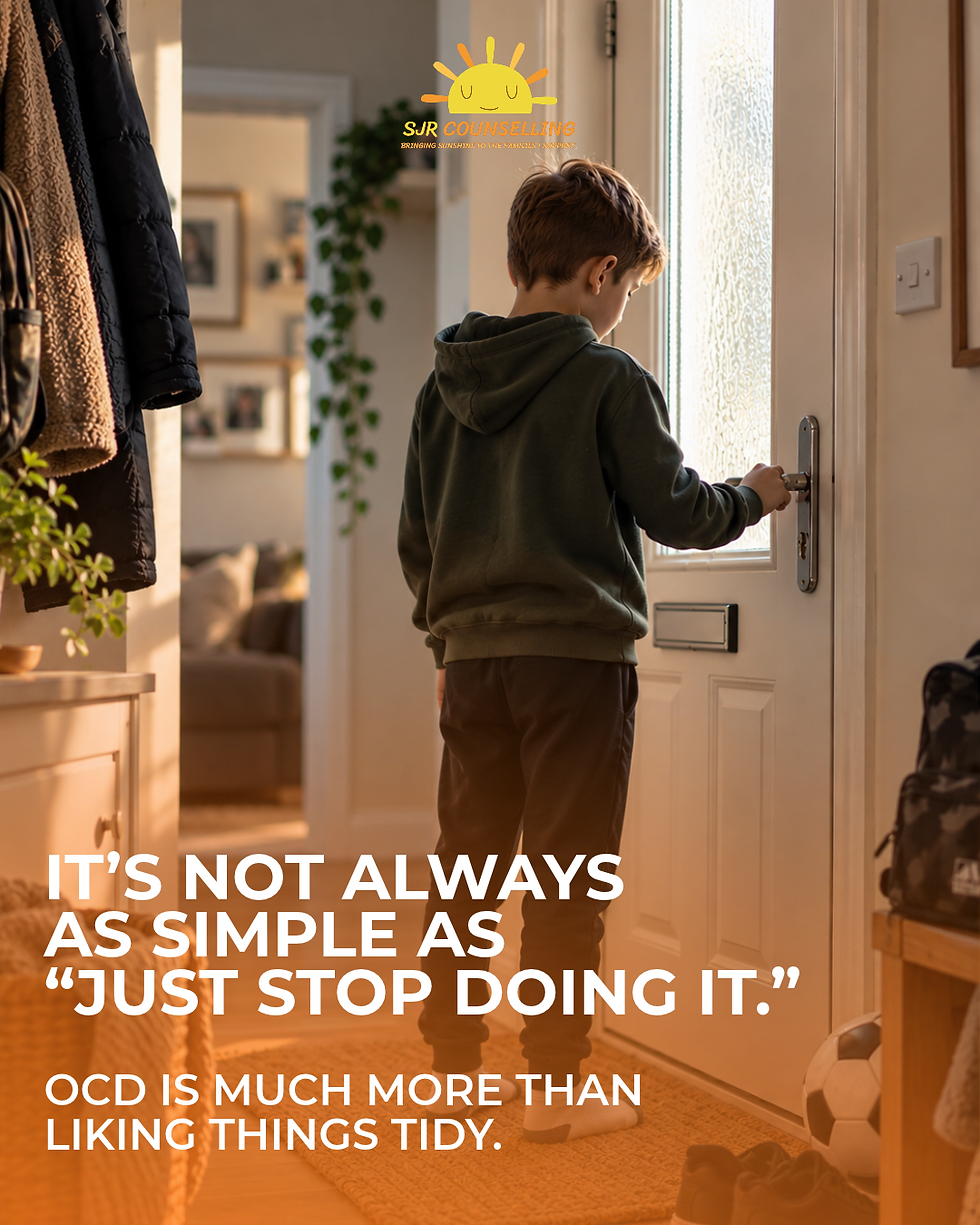
OCD is another really good example of why looking beyond what we can see matters.
We still hear OCD used casually to describe somebody who likes things organised, straight or clean.
But Obsessive Compulsive Disorder is much more complex than that.
Someone with OCD may experience unwanted intrusive thoughts, images, fears or urges that cause significant anxiety.
They may then feel driven to perform a behaviour or mental ritual - a compulsion - in an attempt to reduce that anxiety or prevent something they fear from happening.
From the outside, you might see someone checking the door again.
And again.
And again.
You might hear a child ask the same question repeatedly despite already knowing your answer.
You might notice certain things have to be done in a particular way or that they're suddenly avoiding something altogether.
There can also be compulsions happening entirely inside someone's head that nobody else can see.
So telling somebody to 'just stop doing it' misses what's actually happening.
The behaviour isn't necessarily the problem we need to understand.
What's driving the behaviour?
If you're concerned that you or your child may be experiencing OCD, it's important to seek appropriate professional advice. Your GP is a good place to start.
"But there's nothing to be scared of"

Children can be frightened of all sorts of things.
The dark.
Spiders.
Being away from you.
Going to school.
Getting something wrong.
Someone becoming poorly.
Something they've seen or heard.
Or something that makes absolutely no sense to us.
Our instinct is often to reassure them: "There's nothing to be scared of."
We mean well.
But there's a difference between something being dangerous and something feeling scary.
We might know they're safe.
Their body can still be telling them otherwise.
Instead of immediately trying to convince them that their fear isn't real, we can try becoming curious about it.
"I can see this feels scary for you."
"Do you want to tell me what you're worried might happen?"
"What would help you feel a little safer right now?"
We're not agreeing that the thing they're frightened of is dangerous.
We're recognising that the feeling they're experiencing is real.
And sometimes being understood is exactly where they need us to start.
Understanding children's behaviour & anxiety

A child isn't always going to sit down and say, "I'm avoiding this because I'm frightened of getting it wrong and I'm beginning to believe I'm not clever."
They probably won't tell us, "I'm asking you this question for the tenth time because the reassurance made my anxiety disappear for a moment, but now the doubt has come back."
And they may not be able to explain why their body suddenly feels frightened when, logically, everything around them is safe.
Sometimes we have to look beyond the words.
That doesn't mean every difficult behaviour has a hidden diagnosis behind it.
And it doesn't mean boundaries suddenly disappear.
It means we can hold the boundary while still being curious about what the child might be communicating.
What happened before this?
What are they finding difficult?
What might they need from me right now?
Sometimes changing the question from "How do I stop this behaviour?" to "What might be underneath this behaviour?" can completely change the conversation.
And you don't need to have all the answers
You know your child better than anyone, but that doesn't mean you're expected to understand every behaviour, fix every worry or always know the perfect thing to say.
Sometimes being there matters more than having the answer.
And if things are becoming difficult for your child, or for you, support is available before things have to become unbearable.
I offer Creative Counselling for children, young people and adults, using talking alongside creative approaches to give people different ways to explore what they're experiencing.
Because sometimes finding the words is hard.
And that's okay.

Looking for support?
If you're looking for support for yourself, your child or young person, you can find our more about my Creative Counselling services here on my website.
And if you're not sure whether counselling might be suitable, you're welcome to get in touch.

Comments